May 2026:
European foundry industry remains under pressure in May 2026 while non-ferrous segment shows continued strength
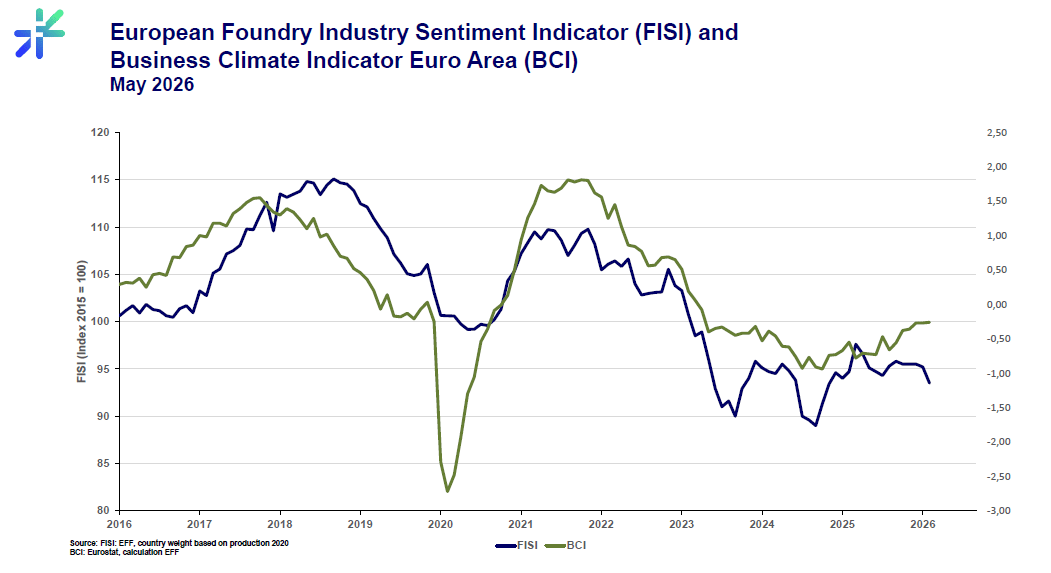
The latest European Foundry Industry Sentiment Indicator (FISI) published monthly by European Foundry Federation (EFF) points to a further weakening of business confidence across much of the European foundry industry in May 2026. While iron and steel foundries reported deteriorating business conditions and lower expectations for the coming months, non-ferrous foundries continued to demonstrate resilience and confidence in future market development.
.
The overall findings reflect a challenging industrial environment in Europe, characterized by subdued demand, economic uncertainty and continued pressure on manufacturing activity.
Iron foundries face declining confidence
In May 2026, European iron foundries reported a decline in both their assessment of the current business situation and their expectations for the next six months. The current situation index fell by 2.4 points to 96.3, while the expectations index declined by 2.7 points to 82.6.The figures indicate that many iron foundries continue to face weak order intake and uncertain market prospects, particularly in sectors linked to traditional industrial production and construction activity.
Steel foundries remain the weakest segment
European steel foundries reported the lowest sentiment levels among all foundry sectors. The current business situation index decreased by 2.0 points to 72.7, reflecting persistently difficult operating conditions. Expectations for the next six months also weakened, declining by 1.5 points to 96.6.Despite expectations remaining close to the neutral benchmark, the sector continues to struggle with insufficient demand and low capacity utilization.
Non-ferrous foundries continue to outperform
In contrast, non-ferrous foundries maintained a strong position. Although the assessment of the current business situation eased slightly by 0.5 points, the index remained at a high level of 132.8. Expectations for the next six months improved further, rising by 1.5 points to 147.4.The positive outlook reflects sustained demand from sectors such as electrification, renewable energy, lightweight mobility solutions and advanced engineering applications, all of which rely heavily on aluminium and other non-ferrous castings.
Broader European economic indicators remain mixed
The developments in the foundry industry correspond with broader economic indicators across Europe.The Euro Area Business Climate Indicator (BCI) remained below its long-term average in May 2026, signalling that confidence among industrial businesses has yet to recover fully. Manufacturers continue to face geopolitical uncertainties, elevated production costs and cautious investment behavior throughout the European economy.
At the same time, the Eurozone Manufacturing Purchasing Managers’ Index (PMI) registered 51.6 in May, remaining above the critical threshold of 50 and indicating modest growth in manufacturing activity. However, the PMI declined from April levels, suggesting that the pace of recovery is slowing.
While manufacturing output continued to expand, businesses reported weaker order growth and ongoing employment reductions. The broader Eurozone Composite PMI remained below 50, highlighting continued economic weakness outside manufacturing.
Industry Outlook
The May 2026 FISI results reveal a European foundry sector operating in a complex and uneven market environment. Ferrous and steel foundries continue to face significant challenges, while non-ferrous foundries benefit from long-term industrial transformation trends associated with the green and digital transitions.
Looking ahead, foundry companies remain cautious. Future developments will depend on the strength of industrial demand, investment activity, energy market stability and the overall economic recovery within Europe.The European Foundry Federation will continue to monitor market developments closely and provide regular updates through the Foundry Industry Sentiment Indicator.
The FISI – European Foundry Industry Sentiment Indicator – is the earliest available composite indicator providing information on the European foundry industry performance. It is published by EFF — European Foundry Federation every month and is based on survey responses of the European foundry industry. The EFF members are asked to give their assessment of the current business situation in the foundry sector and their expectations for the next six months.
The BCI – Business Climate Indicator – is an indicator published by the European Commission. The BCI evaluates development conditions of the manufacturing sector in the euro area every month and uses five balances of opinion from industry survey: production trends, order books, export order books, stocks and production expectations.
Purchasing Managers’ Index (PMI) - in the Euro area is an indicator of the economic health of the manufacturing sector. It is based on such indicators as: new orders, inventory levels, production, supplier deliveries and the employment environment.
EFF Contact:
Witold Dobosz
General Secretariat
mail: info@eff-eu.org