April 2026:
European Foundry Industry faces fragile recovery as April 2026 FISI signals persistent uncertainty
The European Foundry Industry Sentiment Index (FISI), published monthly by European Foundry Federation (EFF), continues to operate in a challenging economic environment marked by uneven demand, weak industrial momentum, and growing uncertainty about future market conditions. According to the latest data the sector shows signs of stabilization in some segments, while confidence regarding the next six months remains fragile.
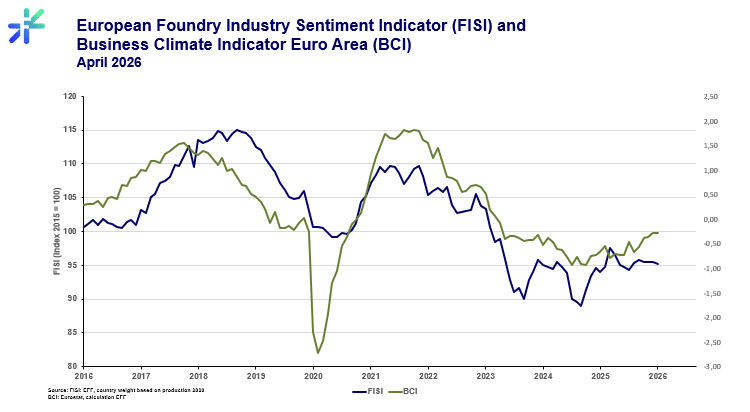
The overall FISI indicator for April 2026 remained below the long-term benchmark, confirming that Europe’s foundry sector is still struggling to regain sustained growth momentum despite isolated improvements in several casting segments.
European Foundry Federation, representing national foundry associations across Europe, notes that foundries continue to face significant pressures from high energy costs, geopolitical instability, weak industrial output in key European markets, and ongoing uncertainty in automotive and manufacturing supply chains.
Ferrous Castings: Stable current conditions but weaker outlook
In the ferrous castings segment, the assessment of the current business situation remained unchanged in April 2026 at 98.7 index points. However, expectations for the next six months declined further to 85.3 points, highlighting increasing caution among iron foundries across Europe. The data suggests that while operational activity has stabilized in the short term, companies remain concerned about future orders, investment activity, and broader industrial demand across the European manufacturing sector.
Steel foundries show slight improvement
The steel castings sector recorded a modest improvement in current business conditions. The current situation index increased by 0.8 points to 74.7 index points in April 2026. Expectations for the next six months remained stable at 98.1 points. Despite the slight improvement, the steel casting segment continues to operate well below historical averages, reflecting subdued demand from heavy industry, machinery, and infrastructure-related sectors.
Non-Ferrous foundries remain the strongest segment
Non-ferrous foundries continue to outperform other parts of the European foundry industry. In April 2026, the assessment of the current business situation increased by 1.8 points to 133.3 index points. At the same time, expectations for the next six months declined by 1.5 points to 145.9 points, indicating that although market activity remains relatively strong, companies are becoming more cautious regarding the sustainability of demand growth in the coming months.
The non-ferrous segment continues to benefit from demand linked to lightweight components, electrification, renewable energy systems, and advanced manufacturing applications.
European Industry still under pressure
The broader Business Climate Indicator (BCI) for the euro area remains in negative territory, reflecting continuing weakness in European manufacturing activity. At the same time, the Eurozone Manufacturing PMI reached 52.2, signaling a slight expansion in manufacturing activity. The latest FISI results underline the close relationship between the foundry sector and the wider industrial economy in Europe.
European foundries remain strategically important suppliers for industries including automotive, machinery, energy, railways, aerospace, defence, and infrastructure. However, the sector continues to call for stronger European industrial policies supporting competitiveness, investment, energy affordability, and industrial resilience.
EFF emphasises that maintaining a competitive European foundry industry is essential for safeguarding industrial sovereignty and securing resilient European supply chains during a period of global economic transformation.
The FISI – European Foundry Industry Sentiment Indicator – is the earliest available composite indicator providing information on the European foundry industry performance. It is published by EFF — European Foundry Federation every month and is based on survey responses of the European foundry industry. The EFF members are asked to give their assessment of the current business situation in the foundry sector and their expectations for the next six months.
The BCI – Business Climate Indicator – is an indicator published by the European Commission. The BCI evaluates development conditions of the manufacturing sector in the euro area every month and uses five balances of opinion from industry survey: production trends, order books, export order books, stocks and production expectations.
Purchasing Managers’ Index (PMI) - in the Euro area is an indicator of the economic health of the manufacturing sector. It is based on such indicators as: new orders, inventory levels, production, supplier deliveries and the employment environment.
EFF Contact:
Witold Dobosz
General Secretariat
mail: info@eff-eu.org