March 2026:
European Foundry Industry shows mixed signals in March 2026 amid moderating outlook.
The European Foundry Industry Sentiment Index (FISI), published monthly by European Foundry Federation, while maintaining the same value as a month before – a level of 95.5 points, presented a mixed performance in March 2026, reflecting cautious stabilization in current conditions but weakening expectations for the months ahead, according to the latest data from the European Foundry Federation (EFF).
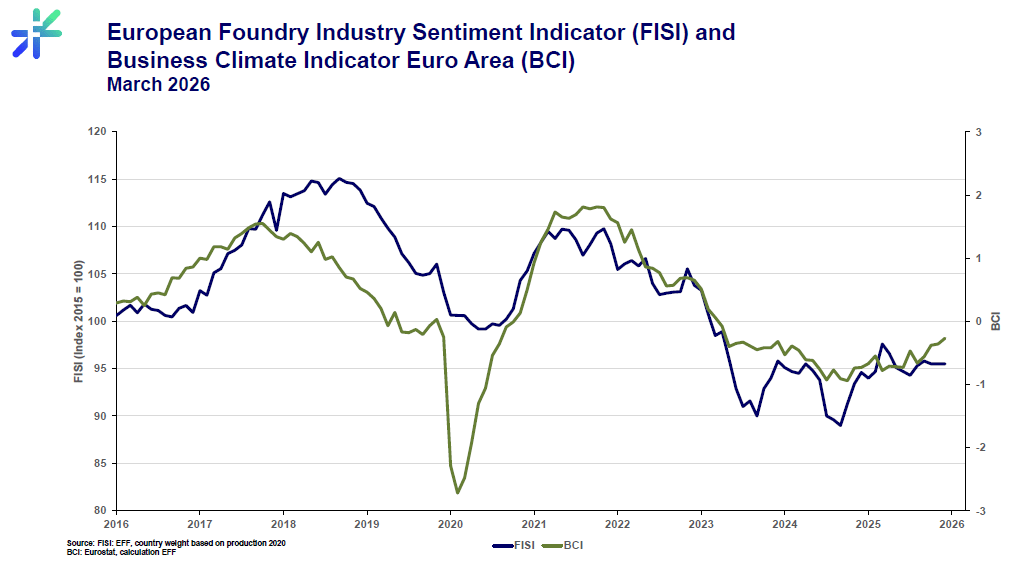
The European Foundry Industry Sentiment Indicator (FISI) for ferrous castings shows that the assessment of the current business situation improved modestly, increasing by 1.8 points to reach 98.7 index points. This indicates a slight recovery in operational conditions across iron foundries. However, industry expectations for the next six months declined significantly by 3.0 points to 86.1 index points, highlighting growing uncertainty among market participants.
A more challenging situation is visible in the steel castings segment. In March 2026, the current business assessment decreased by 2.2 points to 73.9 index points, signaling continued weakness in this segment. Expectations for the next six months also fell by 2.1 points to 98.1 index points, suggesting limited optimism for short-term recovery.
In contrast, the non-ferrous castings segment remains a bright spot within the industry. The current business situation improved slightly by 0.6 points to 131.5 index points, while expectations for the next six months increased by 2.5 points to 147.4 index points. This indicates sustained strong demand and a more positive outlook compared to ferrous segments.
The broader economic environment provides a cautiously supportive backdrop. The Business Climate Indicator (BCI) for the euro area remained in slightly negative territory in March 2026 (-0,27), reflecting ongoing fragility in the overall industrial confidence despite some stabilization trends. At the same time, the Eurozone Manufacturing PMI reached 51.9, signaling a moderate expansion in manufacturing activity. While this suggests improving industrial momentum, it has not yet translated into uniformly positive sentiment across all foundry segments.
Looking ahead, the European foundry industry is expected to navigate a period of uneven recovery. While current conditions in some segments show resilience, declining expectations—particularly in ferrous and steel castings—point to ongoing concerns related to demand volatility, cost pressures, and geopolitical uncertainties.
Non-ferrous foundries are likely to continue outperforming, supported by structural demand in sectors such as automotive electrification and lightweight materials. However, the overall industry outlook remains cautious, with companies closely monitoring order intake and macroeconomic developments.
The coming months will be critical in determining whether the modest improvements in current activity can translate into sustained growth, or whether weakening expectations will lead to a broader slowdown across the European foundry sector.
The FISI – European Foundry Industry Sentiment Indicator – is the earliest available composite indicator providing information on the European foundry industry performance. It is published by EFF — European Foundry Federation every month and is based on survey responses of the European foundry industry. The EFF members are asked to give their assessment of the current business situation in the foundry sector and their expectations for the next six months.
The BCI – Business Climate Indicator – is an indicator published by the European Commission. The BCI evaluates development conditions of the manufacturing sector in the euro area every month and uses five balances of opinion from industry survey: production trends, order books, export order books, stocks and production expectations.
Purchasing Managers’ Index (PMI) - in the Euro area is an indicator of the economic health of the manufacturing sector. It is based on such indicators as: new orders, inventory levels, production, supplier deliveries and the employment environment.
EFF Contact:
Witold Dobosz
General Secretariat
mail: info@eff-eu.org