February 2026:
The European Foundry Industry Sentiment Index (FISI) indicates a cautiously stabilizing outlook in February 2026
The European Foundry Industry Sentiment Index (FISI), published monthly by European Foundry Federation, in February 2026 kept the same level as in previous month – reaching a value of 95.5 points.
The latest data from the European Foundry Federation (EFF), indicate a cautiously stabilizing yet still fragile outlook for the European foundry industry in February 2026. According to the European Foundry Industry Sentiment Index (FISI), the sector presents a mixed picture, with modest improvements in current conditions contrasted by weakening expectations in several segments.
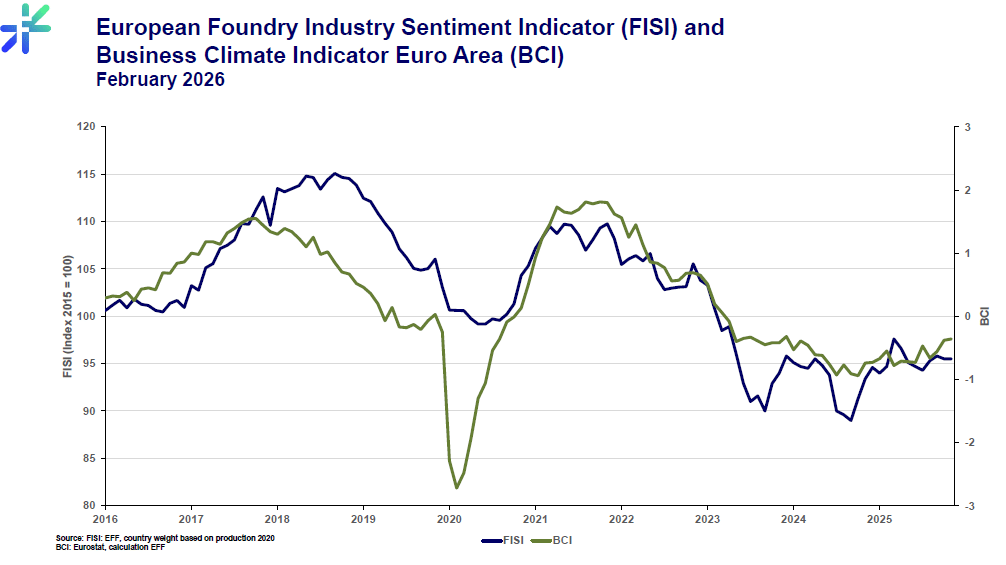
The overall assessment of the current business situation in European iron foundries improved slightly in February, rising by 0.7 points to 96.9. However, expectations for the next six months edged down by 0.1 points to 89.1, signaling continued uncertainty about near-term prospects.
In the steel casting segment, sentiment showed more positive momentum. The current situation index increased significantly by 1.6 points to 76.1, while expectations rose by 1.1 points to 100.2, indicating cautious optimism for recovery in this segment.
Non-ferrous foundries continue to outperform other segments in terms of current activity levels. The current situation index rose by 0.4 points to a strong 130.9. However, expectations declined notably by 2.2 points to 144.9, suggesting that even this relatively robust segment anticipates headwinds in the coming months.
Overall, the FISI remains below its long-term benchmark, reflecting a sector still navigating structural and cyclical challenges. While short-term improvements in current business conditions are evident, particularly in steel and non-ferrous castings, weakening expectations highlight persistent concerns related to demand volatility, energy costs, and broader economic uncertainty in Europe.
The divergence between improving present conditions and softening future expectations underscores the delicate balance facing the European foundry industry. Companies continue to operate in a complex environment shaped by geopolitical tensions, fluctuating industrial demand, and the ongoing transition toward greener production technologies.
EFF emphasizes that maintaining competitiveness will require continued investment in innovation, energy efficiency, and workforce skills. At the same time, supportive policy frameworks at the European level remain essential to ensure the long-term resilience of this strategically important industry.
The Business Climate Indicator (BCI), published by the European Commission, reached ‑0.36 in February 2026, compared to the previous reading of ‑0.38 in January 2026. The Eurozone Manufacturing PMI in February 2026 reached a level of 50.8 which was an increase by 0.7 point from the value of 49.5 in January 2026.
The FISI – European Foundry Industry Sentiment Indicator – is the earliest available composite indicator providing information on the European foundry industry performance. It is published by EFF — European Foundry Federation every month and is based on survey responses of the European foundry industry. The EFF members are asked to give their assessment of the current business situation in the foundry sector and their expectations for the next six months.
The BCI – Business Climate Indicator – is an indicator published by the European Commission. The BCI evaluates development conditions of the manufacturing sector in the euro area every month and uses five balances of opinion from industry survey: production trends, order books, export order books, stocks and production expectations.
Purchasing Managers’ Index (PMI) - in the Euro area is an indicator of the economic health of the manufacturing sector. It is based on such indicators as: new orders, inventory levels, production, supplier deliveries and the employment environment.
EFF Contact:
Witold Dobosz
General Secretariat
mail: info@eff-eu.org