June 2026:
European Foundry Industry shows signs of stabilisation in June 2026 as manufacturing recovery continues.
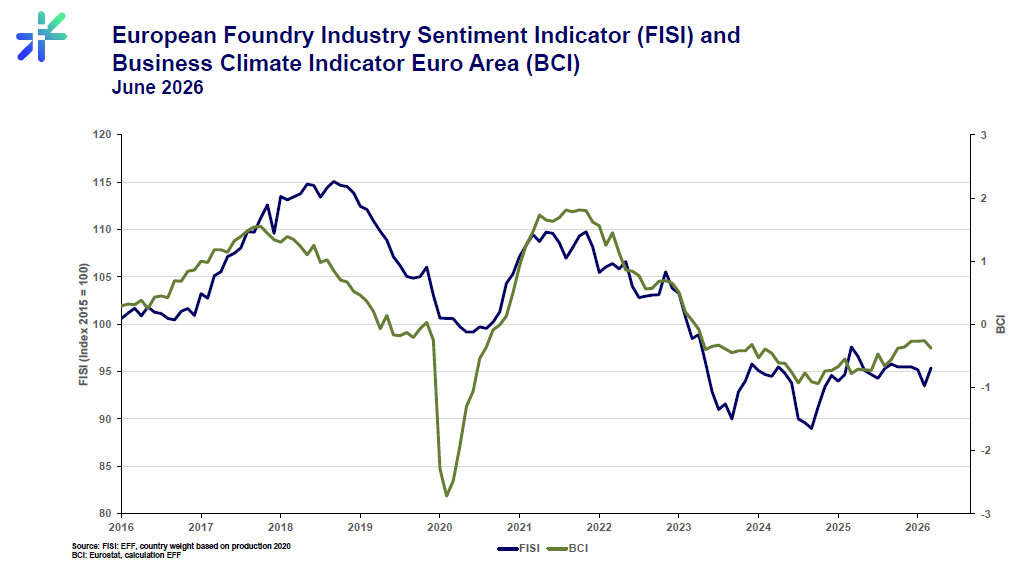
The latest European Foundry Industry Sentiment Indicator (FISI) published monthly by European Foundry Federation (EFF) shows that the European foundry industry recorded its first meaningful improvement in business sentiment after several challenging months. While iron and steel foundries reported stronger business confidence in June, the non-ferrous sector continued to demonstrate resilience despite a slight moderation from exceptionally high levels.
The gradual improvement in foundry sentiment coincides with a stabilising European manufacturing sector. According to the latest survey, the Eurozone Manufacturing Purchasing Managers’ Index (PMI) reached 51.4 points in June 2026, compared with 51.6 points in May 2026. Although the PMI eased marginally month-on-month, it remained above the 50-point threshold for the second consecutive month, confirming continued expansion in manufacturing activity across the euro area and offering cautious optimism for Europe’s casting industry.
Iron foundries regain confidence
European iron foundries recorded a significant improvement in June after several months of declining confidence. The assessment of the current business situation increased by 2.3 points to 98.6 index points, while expectations for the next six months rose by 3.8 points to 86.4 index points. The improvement suggests that demand is beginning to stabilise as manufacturing activity gradually recovers. Nevertheless, expectations remain below the long-term average, indicating that companies continue to adopt a cautious outlook for the second half of the year.
Steel foundries remain under pressure despite improvement
The European steel foundry sector continues to be the weakest segment of the industry, although June brought encouraging signs of recovery. The assessment of the current business situation increased by 1.5 points to 74.2 index points, while expectations for the next six months improved by 2.3 points to 98.9 index points. These results indicate improving confidence; however, steel foundries continue to operate under difficult market conditions characterised by subdued investment demand, low capacity utilisation, elevated energy costs and strong competitive pressure from international markets.
Non-ferrous foundries continue to outperform
The European non-ferrous foundry industry remains the strongest-performing segment of the European casting sector. In June, the assessment of the current business situation declined marginally by 0.9 points to 131.9 index points, while expectations for the next six months decreased by 1.3 points to 146.1 index points. Despite this slight correction, both indicators remain substantially above historical averages, reflecting sustained demand from industries driving Europe’s green and digital transitions, including electrification, renewable energy, lightweight mobility, electrical engineering and advanced manufacturing.
Manufacturing indicators point to gradual recovery
The June FISI results are consistent with broader developments across the European economy. The Eurozone Manufacturing PMI remained in expansion territory at 51.4 points, only slightly below May’s 51.6 points, indicating that manufacturing output continues to grow, albeit at a somewhat slower pace. As foundries typically experience changes in demand shortly after developments in industrial production, these figures suggest that business conditions may continue to improve during the coming months. The Business Climate Indicator (BCI) for the euro area also continued its gradual recovery, supporting the view that industrial confidence is slowly strengthening after a prolonged period of weakness.
Outlook
June 2026 marks an encouraging step towards stabilisation for the European foundry industry. The recovery remains uneven across sectors: while iron and steel foundries are showing the first signs of improving confidence, non-ferrous foundries continue to benefit from structural growth trends linked to decarbonisation, electrification and advanced manufacturing. Nevertheless, important challenges remain. European foundries continue to face high energy costs, geopolitical uncertainty, increasing imports of castings from third countries, and subdued investment in several key customer industries. Sustaining the recovery will depend on stronger industrial demand, supportive European industrial policies and continued improvements in manufacturing activity.
European Foundry Federation (EFF) will continue to monitor developments through its monthly Foundry Industry Sentiment Indicator (FISI) and provide timely market intelligence to policymakers, industry stakeholders and European foundries
The FISI – European Foundry Industry Sentiment Indicator – is the earliest available composite indicator providing information on the European foundry industry performance. It is published by EFF — European Foundry Federation every month and is based on survey responses of the European foundry industry. The EFF members are asked to give their assessment of the current business situation in the foundry sector and their expectations for the next six months.
The BCI – Business Climate Indicator – is an indicator published by the European Commission. The BCI evaluates development conditions of the manufacturing sector in the euro area every month and uses five balances of opinion from industry survey: production trends, order books, export order books, stocks and production expectations.
Purchasing Managers’ Index (PMI) - in the Euro area is an indicator of the economic health of the manufacturing sector. It is based on such indicators as: new orders, inventory levels, production, supplier deliveries and the employment environment.
EFF Contact:
Witold Dobosz
General Secretariat
mail: info@eff-eu.org